

Seen “RTPS” in a message, a bank notice, or a document and wondered what it stands for? You’re not alone. RTPS has no single fixed meaning. It depends on where you see it. In banking and payments, it usually means Real-Time Payment System. In government, tech, and energy, it refers to something entirely different. This guide covers each meaning, then explains how real-time payments work, their pros and cons, and how to use them safely.
What Does RTPS Mean?
RTPS most commonly stands for Real-Time Payment System in finance. That’s what most people searching for this term mean.
Other common expansions:
- Real-Time Publish-Subscribe: a networking protocol used in embedded and industrial systems
- Right to Public Services: a citizen-services law and portal in Assam, India
- Raichur Thermal Power Station: a power plant in Karnataka, India
In casual texting or social media, RTPS isn’t an established slang term. If someone sends it in chat, check the context or ask what they mean.
RTPS Meaning in Banking
In banking, RTPS refers to a system that moves money between accounts within seconds. It works any time of day, including weekends and holidays. Banks and fintechs also call this “instant payments” or “faster payments.”
The label RTPS isn’t an official brand in every country. Networks like RTP (US), FedNow (US), and Faster Payments (UK) do the same job under different names.
RTPS Meaning Can Vary by Country and Context
Context decides the meaning. Use this quick guide:
- Banking or fintech: Real-Time Payment System
- Software, robotics, IoT: Real-Time Publish-Subscribe
- Assam government services: Right to Public Services
- Karnataka energy news: Raichur Thermal Power Station
- Text or social media: Unclear; ask the sender
What Is a Real-Time Payment System?
A real-time payment system is a digital network that lets banks clear and settle individual payments right away. It doesn’t wait for batches or business hours. The sender’s bank checks the payment, the network routes it, and the recipient’s bank credits the account. Both sides get confirmation within seconds.
How Does an RTPS Payment Work?
Here’s a simple example. Sara wants to pay her landlord.
Step 1: Sara Initiates the Payment
She opens her banking app, enters her landlord’s account details and the amount, then submits it.
Step 2: Customer Authentication
Her bank confirms it’s really her. This usually means a PIN, password, fingerprint, or one-time code.
Step 3: Payment Validation
The bank checks that she has enough funds. It also checks that the account details are valid and that the payment looks legitimate.
Step 4: Payment Routing
The payment message travels through the real-time network to the landlord’s bank.
Step 5: Receiving Institution Processes the Payment
The landlord’s bank checks the incoming instruction and accepts or rejects it.
Step 6: Settlement and Fund Availability
Funds settle, the landlord’s balance updates, and both parties receive a confirmation.
What Does “Real Time” Actually Mean?
“Real time” means each payment is handled individually as it happens, not in a batch later. For most payments, that means seconds. It doesn’t always mean zero delay. Extra fraud checks, bank downtime, or network issues can slow things down.
RTPS Means in Text Citation

In articles, contracts, and technical papers, RTPS appears as a defined term. A legal agreement might use it for a company or a set of assets. A networking paper uses it for the Real-Time Publish-Subscribe protocol from the Object Management Group. When you see RTPS in a citation, look for the definitions section. It will state exactly what the author means.
RTPS Meaning in Assamese
In Assam, RTPS refers to the Right to Public Services framework, set up under the Assam Right to Public Services Act. It gives citizens a legal entitlement to notified government services within set timelines. Assam runs an online portal, available in English, Assamese, and Bengali, where residents can apply for services and track progress. It has nothing to do with banking.
RTPS Meaning Medical

RTPS is not a standard medical abbreviation. Hospitals and clinics don’t use it as a recognized clinical term. If you see it in a medical record or prescription, ask the provider to spell it out. Guessing in a health setting is risky.
Real-Time Payment Processing vs. Settlement
People often mix these up. They are two separate stages.
Payment Processing
Processing covers everything up to approval: authentication, checks, and messaging between banks.
Settlement
Settlement is the actual movement of money between the banks’ accounts. In a true real-time system, this happens right after processing, so the recipient can use the funds straight away.
Key Features of RTPS
1. Rapid Transfers
Money typically arrives within seconds.
2. Extended Availability
Most systems run 24 hours a day, seven days a week.
3. Digital Processing
Everything happens electronically, with no paper forms or cheques.
4. Fast Confirmation
The sender and recipient are notified almost immediately.
5. Multiple Payment Use Cases
It supports bills, payroll, invoices, and person-to-person transfers.
RTPS vs. Traditional Bank Transfers
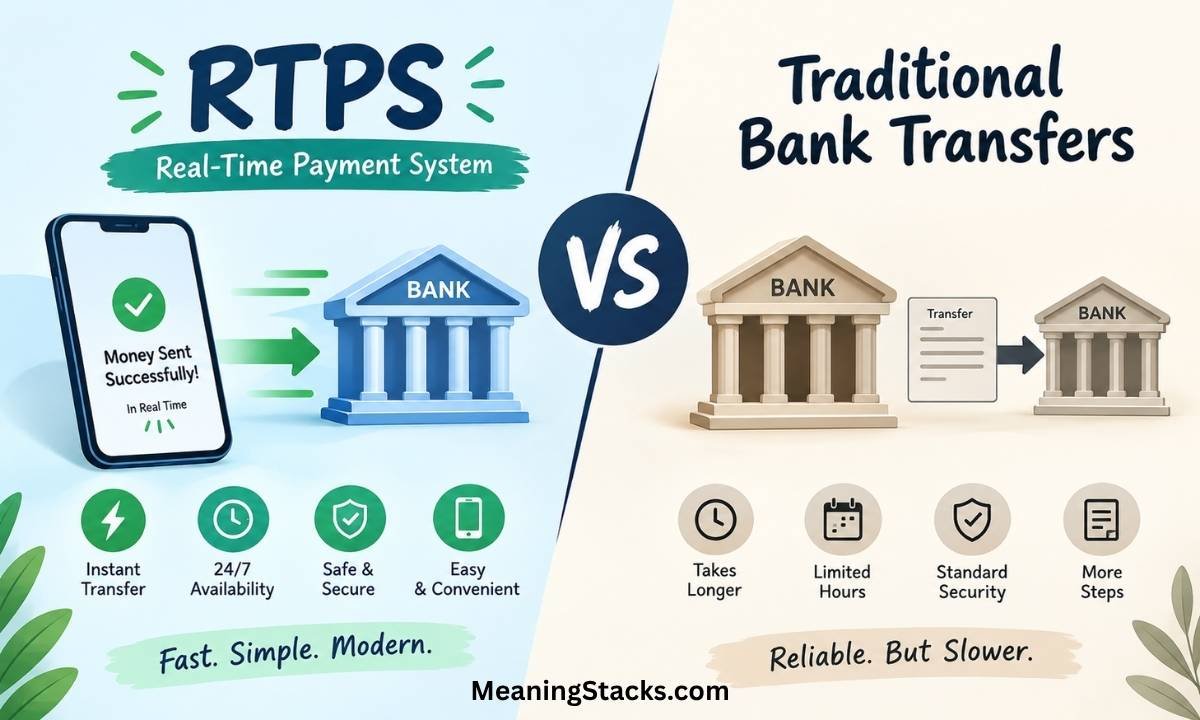
| Feature | RTPS | Traditional Transfer |
| Speed | Seconds | Hours to days |
| Availability | 24/7 | Business days |
| Processing | One payment at a time | Often batched |
| Confirmation | Immediate | Delayed |
RTPS vs. ACH
| Feature | RTPS | ACH |
| Speed | Seconds | Typically 1–3 business days |
| Processing | One payment at a time | Batched at set times |
| Availability | 24/7, including holidays | Business days only |
| Confirmation | Immediate | Delayed |
| Cost | Varies; may carry a small fee | Usually low-cost |
| Reversibility | Difficult once settled | Easier within set return windows |
| Best for | Urgent, time-sensitive payments | Recurring, scheduled payments like salaries and utilities |
Bottom line: RTPS wins on speed and availability. ACH remains a strong choice for large, scheduled, low-cost payment volumes.
RTPS vs. Wire Transfer

| Feature | RTPS | Wire Transfer |
| Speed | Seconds | Minutes to hours (same day for domestic; longer for international) |
| Availability | 24/7, including holidays | Usually banking hours only |
| Cost | Often lower for domestic transfers | Usually higher, with flat fees per transfer |
| Transaction Limits | Capped by network and bank | Much higher; suited to very large sums |
| International Payments | Limited; mostly domestic | Widely supported |
| Reversibility | Difficult once settled | Also difficult once completed |
| Best for | Everyday domestic and time-sensitive payments | Large-value and cross-border payments |
Bottom line: RTPS is faster to access and cheaper for domestic transfers. Wires remain the better choice for very large or international payments.
RTPS vs. RTP: Are They the Same?
Not exactly. RTPS is a general phrase for real-time payment systems. RTP is often the name of a specific US network run by The Clearing House. Think of RTP as one example of an RTPS.
Benefits of Real-Time Payments
Faster Access to Funds
Recipients can spend or reinvest money immediately.
Better Customer Experience
Instant confirmation reduces “Did it go through?” anxiety.
Improved Business Cash Flow
Businesses get paid sooner, which cuts gaps between bills and income.
24/7 Payment Capability
Payments work on nights, weekends, and holidays.
Reduced Reliance on Cash
Digital transfers replace cash handovers and cheques.
Faster Business Operations
Payroll, supplier payments, and refunds all move quicker.
Disadvantages of Real-Time Payments
Difficult-to-Reverse Transactions
Once money moves, getting it back is hard.
Fraud and Scam Risk
Scammers like fast, final payments because victims have little time to react.
Transaction Limits
Banks often cap the amount per payment.
Service Availability
Not every bank or region supports it.
Technical Problems
Outages or app glitches can delay or interrupt transfers.
RTPS Fees and Transaction Costs
Costs vary by bank and country. Some banks offer real-time payments free to consumers. Others charge a small fee. Businesses may pay per transaction. Always check your bank’s fee schedule before sending.
RTPS Transaction Limits
Limits depend on the network and your bank. Some networks allow very high per-payment amounts, but your own bank may set a much lower daily cap. Check your app or call your bank if you need to send a larger amount.
Is RTPS Available 24/7?
Usually yes. The networks are built to run around the clock. Your individual bank may still have maintenance windows or may not offer the service on all channels.
Is RTPS Safe?
Generally yes, because banks use encryption, authentication, and fraud monitoring. The real risk is human error and scams, not the technology itself.
How to Use Real-Time Payments Safely
- Double-check details before you hit send.
- Verify the recipient with a call or a known contact.
- Turn on multi-factor authentication.
- Avoid urgent requests from unknown people.
- Set sensible limits in your banking app.
- Never share one-time codes with anyone.
What Happens If You Send an RTPS Payment to the Wrong Person?
Contact your bank immediately. Ask them to request a return from the recipient’s bank. Recovery is not guaranteed because the recipient must usually agree, and speed matters. Report the incident, keep screenshots, and file a fraud report if you suspect a scam.
Examples of RTPS Use Cases
Person-to-Person Payments
Splitting rent or repaying a friend.
Small-Business Payments
Paying a supplier the same day.
Merchant Payments
Accepting instant payment at checkout.
Freelance and Gig Payments
Paying contractors as soon as work is done.
Emergency Transfers
Sending money to family late at night.
Business-to-Business Payments
Settling invoices without waiting for batch cycles.
RTPS for Consumers
Consumers gain speed, convenience, and instant confirmation. It suits urgent bills and personal transfers. The trade-off is that you must be careful, because mistakes are harder to undo.
RTPS for Businesses
Businesses improve cash flow, reduce late payments, and simplify reconciliation. Faster payouts to staff and vendors also build goodwill. Companies should add fraud controls and approval workflows to protect against errors.
Common RTPS Misconceptions
“RTPS Always Means One Specific Payment Network”
False. It is a general term, and networks differ by country.
“Every RTPS Payment Is Completely Instant”
Most are fast, but checks or outages can cause delays.
“Every Bank Supports RTPS”
No. Participation varies by bank and region.
“RTPS Payments Are Always Free”
Not always. Fees depend on your bank and provider.
“Real-Time Payments Have No Security Checks”
Wrong. Authentication and fraud screening happen in seconds.
Frequently Asked Questions
What does RTPS stand for?
Most often, Real-Time Payment System. It can also mean Real-Time Publish-Subscribe or Right to Public Services.
Is RTPS a slang term in texting?
No. It has no standard slang meaning, so check the context.
Is RTPS the same as RTP?
Not exactly. RTP is one specific network, while RTPS is the general concept.
How fast is an RTPS payment?
Usually within seconds, though checks or outages can add delay.
Can I cancel an RTPS payment?
Rarely. Once settled, you need the recipient’s cooperation to reverse it.
Does RTPS work on weekends?
Yes, most systems run 24/7, but your bank may have exceptions.
Are RTPS payments free?
It depends on your bank. Some are free; others charge a small fee.
Is RTPS used in healthcare?
No. It isn’t a standard medical abbreviation.
Conclusion
RTPS means different things in different places. In banking, it means a Real-Time Payment System that moves money in seconds, any day of the week. In tech, government, and energy, it points elsewhere. Always read the context before assuming.
If you use real-time payments, remember the rule that matters most: speed cuts both ways. Verify every recipient, use strong authentication, and know your bank’s fees and limits.

John Marvel has 4 years of experience writing and researching language, slang, abbreviations, and related topics.
He enjoys exploring relevant subjects and making complex terms easy to understand.
His aim is to share useful knowledge through clear, simple, and helpful content.
He is passionate about helping people find accurate answers quickly.