

You scroll for two minutes and see “POV:” at the top of five different videos. It looks like code, but it isn’t.
POV means “point of view.” On social media, it has become a quick way to say, “Imagine you’re in this situation.” This guide covers what it means, where it came from, how people use it on each app, and how to reply when someone sends it to you.
POV – Quick Meaning
Simple Definition:
POV = Point of View. In online slang, it introduces a scenario or feeling and asks you to see it from a specific person’s perspective, often yours.
Quick Examples:
- “POV: It’s Sunday night, and you remember the homework.”
- “POV: You hear your favorite song in a shop.”
- “POV: Your phone is at 1%, and the charger is across the room.”
Origin & Background
Traditional Meaning
Long before apps, “point of view” described how a story is told or how someone sees an issue. In writing, it covers first person (“I”), second person (“you”), and third person (“he/she/they”). In film, a POV shot shows the scene through a character’s eyes.
How It Became Internet Slang
Short-video apps pushed the film idea into everyday language. Creators began opening clips with “POV:” so viewers would feel like they were inside the scene rather than watching it. Because it was short, funny, and easy to copy, it spread to captions, memes, comments, and group chats. Today most people use it loosely, even when no real “perspective” is involved.
POV Meaning in Text Urban Dictionary
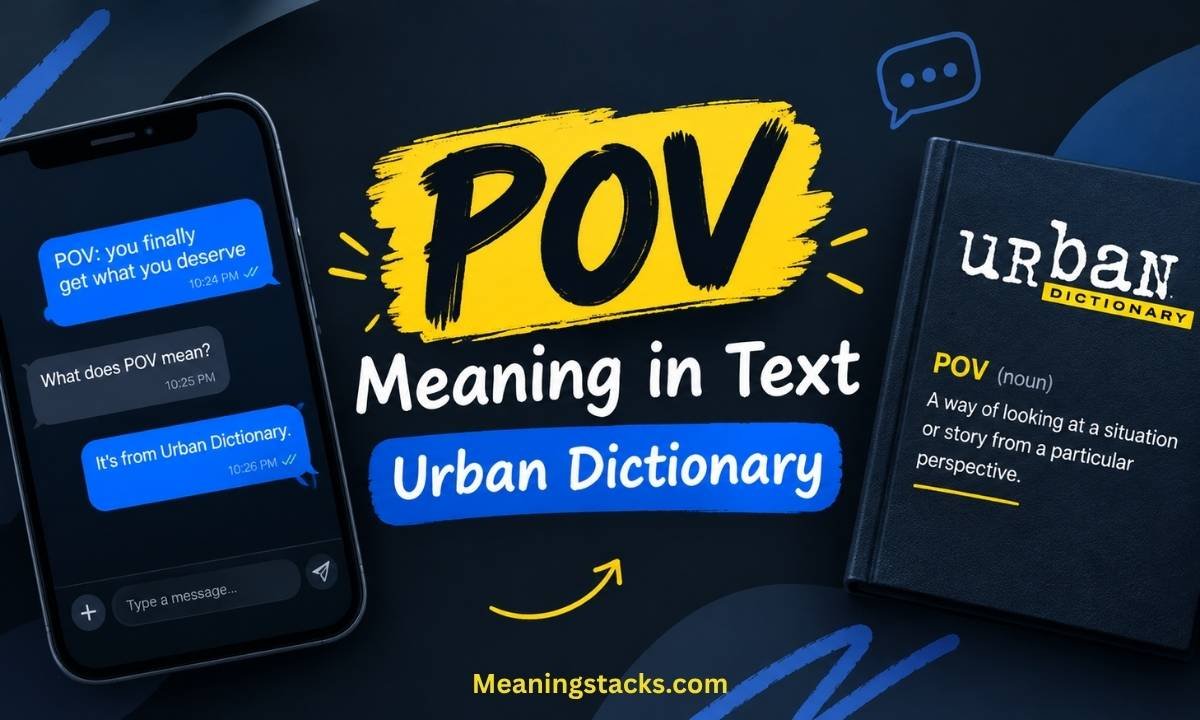
Slang dictionaries like Urban Dictionary describe POV as shorthand for “point of view,” often used to set up a joke, a relatable moment, or a role-play. Because entries there are user-written, they vary in tone and accuracy. Treat them as a snapshot of how people use the word, not as an official definition.
In texting, POV usually means one of two things:
- “Here’s how I see it” (a real opinion).
- “Picture this” (a joke or relatable scene).
Real-Life Conversations
1) WhatsApp Chat
Sara: POV: it’s Monday, and my alarm just went off 😩
Ali: Same energy. Coffee first.
2) Instagram DMs
Mina: POV: you finally get tickets after 40 minutes in the queue
Zoya: I’m crying, send me that reel.
3) TikTok Comments
Comment: POV: you’re the only one who studied for the quiz
Reply: This is literally my life.
4) Text Message
Hamza: POV: you said “five minutes” an hour ago
Bilal: Okay okay, I’m leaving now.
5) Funny Friend Chat
Amna: POV: you ordered one fry and ate the whole box
Hira: Don’t expose me like that 😂
Emotional & Psychological Meaning
POV is small, but it does real work in conversation. Here’s why it sticks.
1) It Makes People Feel Seen
A good POV describes something many people have felt but never said. Seeing it spelled out feels validating.
2) It Creates Instant Connection
Replying “this is so me” takes one second and builds a shared moment. That’s why POV posts get so many comments and shares.
3) It Reflects Modern Identity
People use POV to show who they are: the tired student, the loyal friend, the overthinker. It’s a light, playful way to share personality.
4) It Feels Personal Without Being Too Deep
You can admit you’re stressed or lonely in a joking format. It opens a door without forcing a heavy talk.
POV Mean Streak
People often search “POV mean streak,” so here is the clear answer. A mean streak is an old expression for a tendency to be unkind or harsh. It has nothing to do with the “POV” slang itself.
The two can still meet in one caption, such as “POV: your friend has a mean streak and just roasted your outfit.” Here, POV simply sets up the scene, and “mean streak” describes the person in it.
Usage in Different Contexts
1) Social Media
How it works:
You write “POV:” followed by a situation. The video, photo, or text then plays out that situation.
Example:
“POV: You’re a barista, and the milk just ran out.” The creator acts the scene while the caption sets the stage.
Purpose:
- Grab attention in the first second
- Make the viewer feel part of the story
- Invite comments like “so true”
2) Friends & Relationships
Example:
“POV: You’re my best friend, and I’m about to tell you a long story.” (playful, warm)
Example:
“POV: You’re waiting for my reply, and I’m still in the shower.” (teasing, light)
Between friends, it works as banter. In romantic chats, it can be flirty or sweet, but tone matters. Read the mood first.
3) Work or Professional Settings
Appropriate professional uses:
- Casual team chats
- Brand posts aimed at a younger audience
- Internal jokes among colleagues who know each other well
Example:
“POV: It’s the last hour before the weekend 😄” in a friendly team channel.
Important:
Skip it in emails to clients, managers you don’t know well, or formal reports. Slang can read as unserious. When in doubt, write “from my perspective” or “in my view.”
4) Casual vs Serious Tone
Casual POV
Playful, exaggerated, and meant for laughs. Most POV posts are like this.
Serious POV
Used to share a genuine viewpoint, like “My POV is that we should move the deadline.” This is the traditional meaning, and it’s fine in conversation and discussion.
Common Misunderstandings
1) Using POV for Something That Isn’t a Perspective
Writing “POV: new shoes” with no scene or feeling doesn’t work. A POV needs a situation the viewer can step into.
2) Confusing POV With Opinion
They overlap but aren’t the same. An opinion says what you think. A POV shows how something looks from a position.
Example:
- Opinion: “Pineapple on pizza is great.”
- POV: “POV: You’re the only one who ordered pineapple pizza.”
3) Using It in Very Serious Situations Without Sensitivity
A joking format can feel dismissive when someone is hurting.
Avoid using it when:
- Someone is grieving or sharing a personal struggle
- The topic involves health, loss, or conflict
- You’re unsure how the other person will take it
Comparison Table
| Term | Meaning | Tone | Typical Example |
| POV | Scenario seen from a perspective | Casual or funny | “POV: you missed the bus” |
| Opinion | What someone thinks | Neutral | “I think it’s too long” |
| Perspective | Broader way of understanding | Thoughtful | “From a student’s perspective…” |
| Relatable (meme) | Shared experience | Light | “Me every Monday” |
| Mood | Current feeling | Casual | “Mood: tired” |
Key Insight:
POV is the only one of these that puts the reader inside the situation.
Variations / Types of POV
1) Funny POV
Exaggerated everyday moments. “POV: You said you’d sleep early. It’s 3 a.m.”
2) Romantic POV
Sweet or cinematic. “POV: You’re getting a handwritten note from your crush.”
3) Sad POV
Emotional or reflective. “POV: You scroll through old photos at midnight.”
4) Confidence POV
Self-hype. “POV: You walk in knowing you nailed the presentation.”
5) Friendship POV
Inside jokes and loyalty. “POV: Your friend sits beside you without asking why.”
6) Family POV
Home life. “POV: Mom says ‘we’re leaving in five minutes’ and it’s been an hour.”
7) Student POV
Exams, deadlines, group projects. “POV: You open the exam paper and recognise nothing.”
8) Work POV
Office life. “POV: Your meeting could have been an email.”
9) Fashion or Beauty POV
Style and routines. “POV: You finally found the right shade of foundation.”
10) Cinematic POV
Filmed from the first-person angle, like a camera behind someone’s eyes. These are often used for travel, sports, and food.
How to Respond When Someone Uses It
You don’t need a special reply. Match their tone. Here are options for each mood.
Casual Replies
- “Haha, so true.”
- “Okay, I felt that.”
- “Same, honestly.”
Funny Replies
- “Why are you describing my entire week?”
- “Stop, you’re calling me out.”
- “Plot twist: it’s me.”
Mature / Confident Replies
- “Fair point. I see where you’re coming from.”
- “Thanks for sharing your view. Here’s mine.”
Private or Respectful Replies
- “Sounds like a lot. Want to talk about it?”
- “I’m here if you want to chat.”
Use this last group when a “joke” POV seems to hide a real feeling.
Regional & Cultural Usage
1) Western Culture
Common style:
Humor, sarcasm, and pop-culture references. POV appears in memes, Reels, and fast-paced skits.
2) Asian Culture
Common style:
Often tied to school, exams, family expectations, and aesthetic vlogs. Many creators mix English POV captions with local languages.
3) Middle Eastern Culture
Common style:
Family gatherings, food, weddings, and friendly teasing. Creators often blend Arabic or Urdu with English in the same caption.
4) Global Internet Usage
POV has crossed language barriers. Even in places where English isn’t the first language, people understand “POV:” instantly because the video does most of the explaining. That’s part of its strength as a universal format.
Frequently Asked Questions
What does POV stand for?
It stands for “point of view.”
What does POV mean in text?
It means either “here’s how I see it” or “imagine this scenario,” depending on the message.
What does POV mean on TikTok?
It’s a caption that puts the viewer inside a scene or role.
Is POV the same on Instagram and Snapchat?
Yes. The meaning is the same, though Reels lean more aesthetic and Snapchat feels more casual.
Is it rude to use POV in chat?
No, but avoid it during serious or emotional conversations.
Can I use POV at work?
Only in casual team chats. Use “from my perspective” in formal writing.
Does POV always need a colon?
Not always, but “POV:” followed by a scenario is the most common and clearest style.
Is “POV mean streak” a slang term?
No. “Mean streak” is a separate phrase for an unkind tendency and can appear in a POV caption.
Conclusion
POV started as a film and writing term and became one of the internet’s most useful shortcuts. On TikTok, Instagram, Snapchat, and in everyday texts, it invites people to step into a moment and feel it.
Use it for relatable, playful, or reflective scenarios. Keep it out of formal settings and sensitive moments. And if you’re ever unsure how it’s meant, check the tone. A joke gets a joke back, and a quiet message deserves a caring reply.

John Marvel has 4 years of experience writing and researching language, slang, abbreviations, and related topics.
He enjoys exploring relevant subjects and making complex terms easy to understand.
His aim is to share useful knowledge through clear, simple, and helpful content.
He is passionate about helping people find accurate answers quickly.